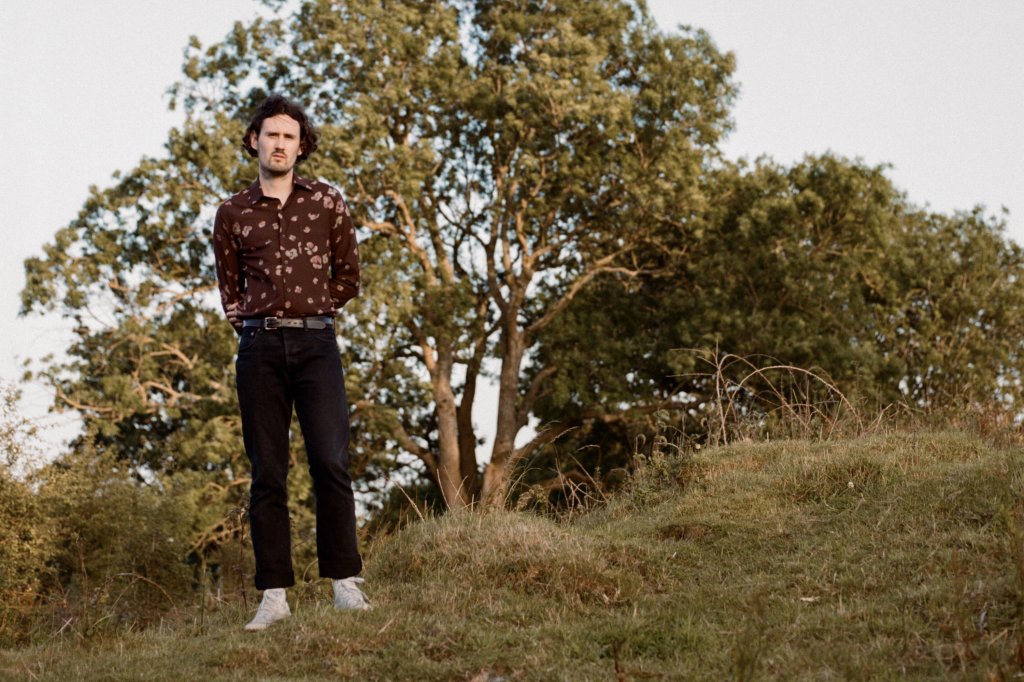
Up until a couple of weeks ago, I was completely unaware of Campbell Sibthorpe. In fact it was only through setting up this blog that I chanced upon the Australian-born, London-based songwriter, when his recent EP – the superb ‘Ytown’ – found it’s way into my inbox. Calling to mind artists such as Fleet Foxes, Midlake and The Shins, it’s exactly the reason I wanted to get this thing off the ground in the first place – to find music that really needs to be heard. Saying that, I was still surprised that something so fully-realised should appear so soon.
If you haven’t yet heard the EP (or read the review) then now is a good time to do so. In short, ‘Ytown’ is a sublime collection of folk pop songs that chronicle the adolescent yearning to leave one’s hometown, seen through the eyes of the same little kid who left returning as an adult. The songwriting is a joy, and the production work is equally so. Essentially, I was blown away by it (and spent a long time gushing on about this kind of stuff in the review) so I’ll just leave it at that. As I said above, if you’re reading this and you’re not familiar with his work, then check it out here.
I didn’t know much about Campbell at all. Biographical information was scarse – apart from details gleaned from a press release about moving to England as a child and growing up in a small village near Bristol. The same document also stated that it was while working as a cleaner in a school a couple of years ago that he realised making music was where he wanted to be.
I knew from the first time I played through ‘Ytown’ that I wanted to fire a few questions across to Campbell, to find out more about how such a cohesive and satisfying project came to be, but also to discuss how he goes about writing and recording. To begin our conversation, I wanted to focus on that decision to down tools at the school and pursue music.
(Note: to make things easy to follow, my questions are presented in bold, and Campbell’s responses in plain text)
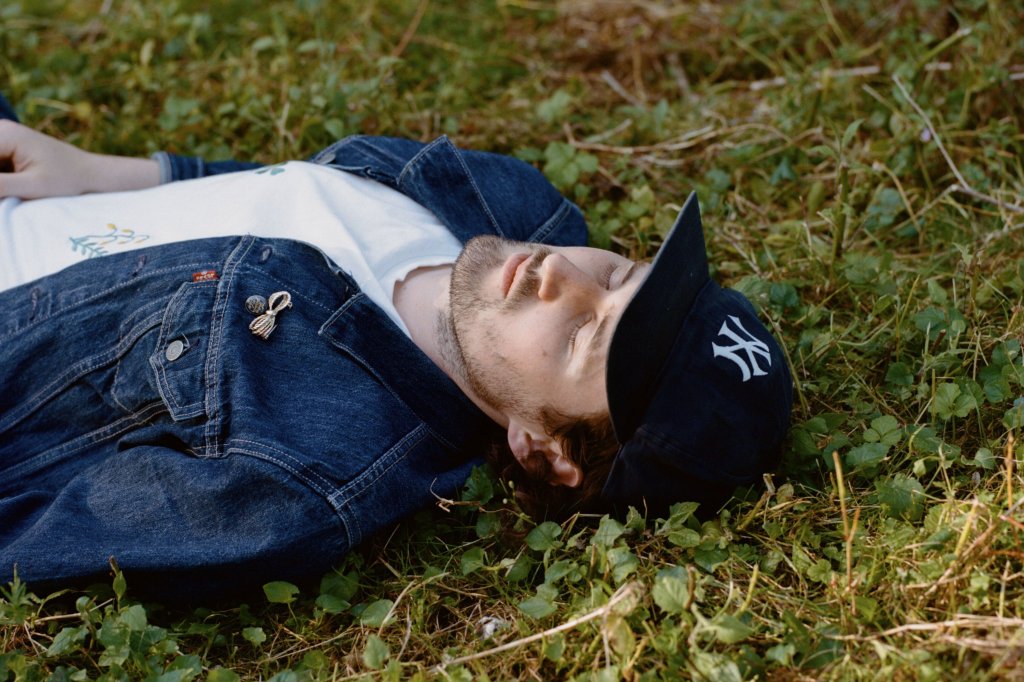
• I read that it was while sweeping school halls in 2017 that you realised that music was what you wanted to be doing. Since ‘Ytown’ was my introduction to your music (though I’ve since binged your previous work on Spotify), could you elaborate a little on what you were doing before and what kind of clicked into place?
I’d just returned to the UK after traveling in America and I was in desperate need of a job. I’d worked for a start-up prior to traveling and I wanted to do something totally different and use it as a stopgap between whatever was next. The week before I went for the interview at the school I’d opened a fortune cookie from the local Chinese and it read “the next interview you have will result in a job”, and well I guess the OCD gods were shining over me because I got the job.
Working at the school gave me a huge amount of opportunity to work on ideas. I’d walk around the site with a notepad and my phone and if something came to mind I would sneak off into a room and quickly make a recording or a note. I’ve always found cleaning therapeutic and so spending six hours a day mostly to myself gave a lot of time for ideas to manifest themselves. It was during this period that I started trialing the songs at local open-mic nights and then to my surprise people really connected with them and things started moving from there. It felt assuring that things were aligning even if I had to return to school to mop a trashed cafeteria the next morning.
• It strikes me that your music doesn’t sound like somebody who has just started writing songs. As I said in my review of the EP, there’s a real assuredness to your writing. There’s a sense of ‘okay, this guy knows how to write’. How have you arrived at this point? I guess I’m also asking whether you think that songwriting is as much a craft as it is inspiration…
I really tried to work on finding my voice and finding what I wanted to say with my music. I was influenced by writers who, for me, were opening a new world of language that I hadn’t explored before. I really dived in deep. I would listen to a lot of music, absorb and analyse the lyric books and write poems to expand my vocabulary. I’ve always been interested in the mechanics of how a song takes form, so I feel this curiosity has given me the good groundwork to launch myself into the writing without feeling the constraints of what might be deemed as the “right way” to do it.
For the most part, it begins with a moment of inspiration and then it just turns into editing. Often I find it’s about preserving that moment of inspiration during the editing process that is the hardest part to get right. I’m trying to remain true to an initial feeling whilst knowing I might be destroying it at the same time. Sometimes it’s an easy game but for the most part it’s a long one.
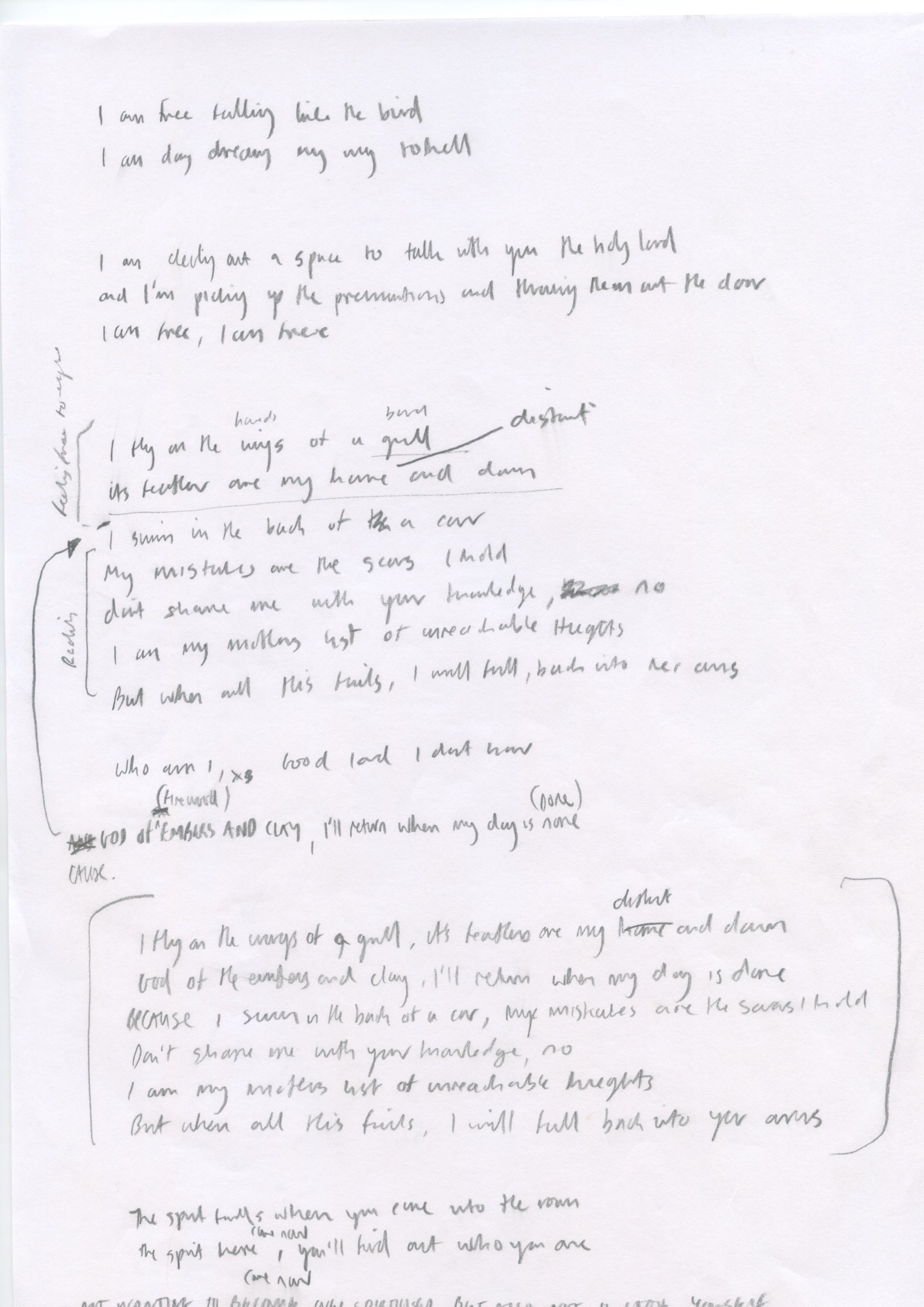
• How do you tend to write? Do you have a specific idea or goal in mind when you start a song, or are you kind of letting the melody or lyrics dictate where you go next? Take songs like ‘Father Carpenter’ and ‘Good Lord’ for example – how do you begin with tracks like those?
I tend to store away a lot of the lyrics in my notebook or phone and then return to them if they speak to me. If I record an idea on my phone and within the first couple of hours I’m not humming it back to myself I don’t really ever return to it. A lot of ‘Ytown’ was written from this practice. A lot of driving to work and just singing nonsense, throwing melody at a wall and seeing what would stick.
‘Father Carpenter’ was one of those magical moments where everything aligned and one moment there was nothing and then the next there was a song. I remember I was driving through the country lanes and this melody came into my head and so I pulled over and recorded it. I felt like I’d hit the jackpot. Once that initial recording was made it was a relatively quick process to get the rest down. I had the line “Father you carved our names on to the tree, where history would read the dead and see, we were once friends” and from there I just wrote the song retrospectively. The song is very literal, it was just a case of casting my mind back ten years or so. However, writing ‘Good Lord’ felt like a long road to get to a place where I could sign it off. Structurally and melodically everything was there and all worked together well but lyrically it was a mess and I had no idea what I was actually trying to say. I remember looking at the lyrics one day and thinking, “wow I’m really bad at this”, I feel like I worked my socks off for that song.
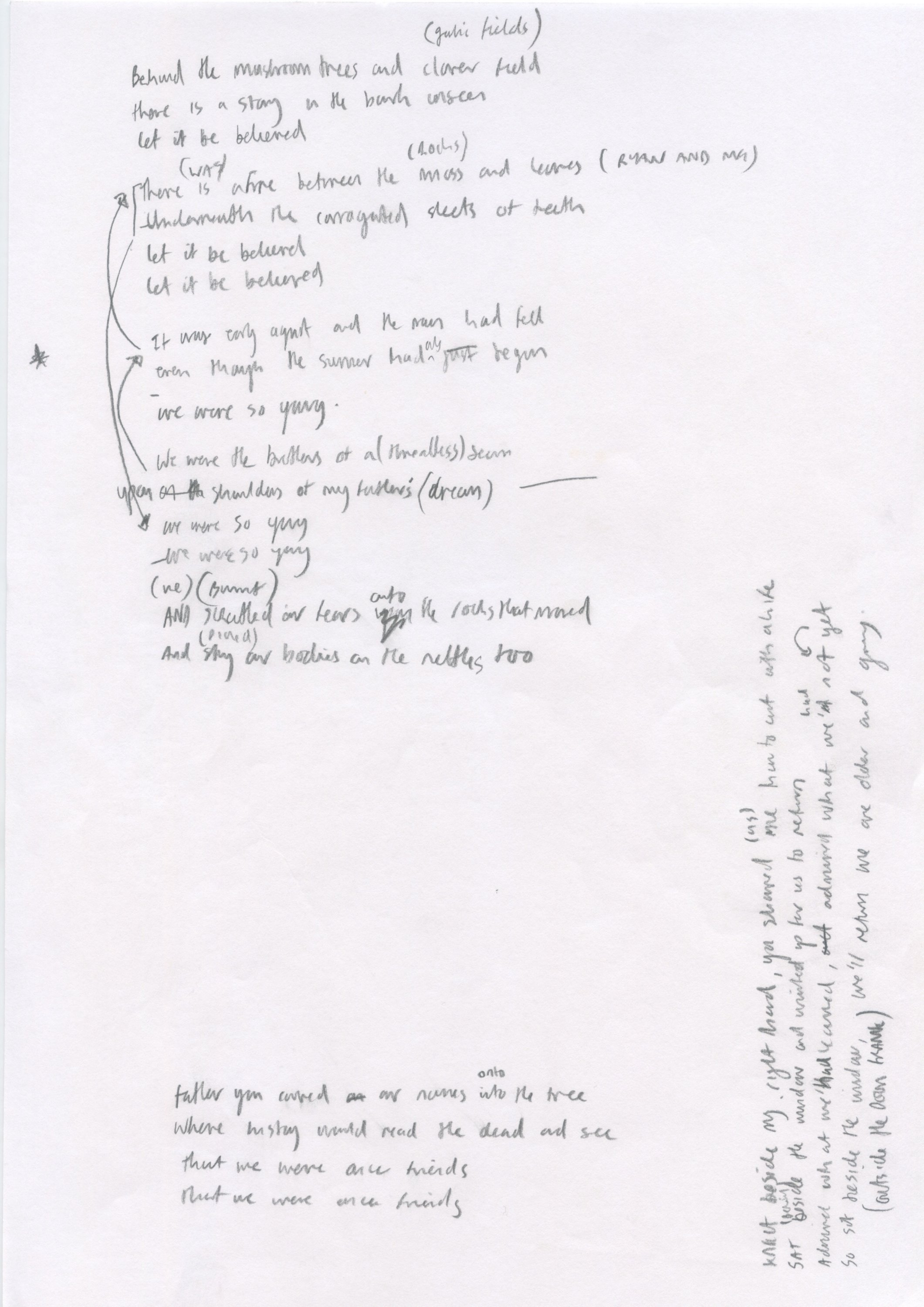
• I really liked the idea of opening and closing the EP with short songs. Both are great for different reasons, but ‘Strawberry Line, Pt.2’ in particular feels as though, in another life, it could have been two or three times the length. Having the confidence to cut off where it does really struck me as being a bold move. It says all it needs to say in those 90-odd seconds. I’ve gone around the houses here, but I think I’m asking how you know that a song is ‘there’. Was the length of the EP something you thought a lot about?
The length of the record was something I considered a lot. I was certain the EP would just end with an instrumental and that would be it, but once I had it I felt I needed to say something more. I’d been living with the record for a long time so when I decided to write ‘Strawberry Line, Pt.2’ to close out the EP it was all I had left in me to say. I think you learn to be sensitive to whether adding another line or verse will actually take away from what you believe is complete.
• Sticking with writing: you pay a range of instruments. Do you primarily write on one or do you find yourself switching between them? Personally speaking, I know that I will find myself getting drawn into the same kind of areas if I don’t switch. I remember when I was a teenager and I discovered the joy of a C chord into a B7 for example, and I must have unconsciously worked those into everything I did for years. I think that’s because I only played guitar then, so it was very easy to repeat. Do you find you write yourself into a corner at times?
I’m a chord enthusiast at heart but when I feel like I might be going through the motions on the guitar I’ll use the piano to kick myself out of the rut. Sometimes the piano allows me to take the song somewhere totally different. A lot of the time it’s only when I come to the recording that I’ll start moving between different instruments and exploring different options.
• Aside from the songs themselves, one of the most impressive things about ‘Ytown’ is the production. In my review, I spoke about how I really enjoyed the ambient sounds you incorporated – such as the squeaking of chairs, footsteps, and birdsong – and I thought that the whole thing just sounded great. How did you get into the production side of things?
I started producing when I was at school and though it was a long time before I started working on my own project, I wasn’t ever far from it. It was only when I set about recording my first EP ‘Sky Lily’ that I picked up the hat again, and though it is far different in production quality it gave me the confidence to approach ‘Ytown’ with a level of authority.
In terms of incorporating the field recordings, I decided early on that I wanted to try and soak the EP in the sounds of where I’d grown up. I wanted to give the songs an environment to live within and it felt like the most natural way to capture a small essence of the village I was trying to conceptualise. When we headed to the studio to mix and master I suddenly could hear all these extra moments of external sounds, for instance, in ‘The Sun Appeared’ you can hear the wind blowing, which is actually the sound of a plane passing over the roof. We did some work on it and turned it into something beautiful, but boy did I try and make sure you never heard the white noise of a plane bleed through. Surprisingly, I think it’s these subtle moments throughout the record that add depth and give the record life.
• Could you talk a little about the recording process? I understand you did pretty much everything from the bedroom of your childhood home, featured your sister on backing vocals on some tracks, and used the pump organ from the local church. Why was it important for you to record these songs this way?
Keeping everything as local gave me a lot more time to experiment and re-record songs in different ways. I didn’t have the pressure of money and a clock ticking at a studio, and though that pressure can be helpful, being able to work at my own pace enabled me to get the best out of the songs. I was incredibly apprehensive to record ‘Ytown’, I’d built the songs up in my head so much that I was scared to even set foot in them. Recording it from my bedroom just ended up being the most comfortable way to approach the EP.
Adding my sister in on vocals on ‘Pastel Porcelain’ and ‘Dandelion’ was me paying homage to a lot of our early years singing together. Her voice is beautiful and I knew it would add something special to the songs, even when I had to remind myself that I was her brother, not the producer when we’d need to throw in the towel to avoid an argument. To have someone else come in and record with me made the experience a whole lot more enjoyable, I’d been working solo for so long that to have someone else around gave the project new life and gave me the drive to get the work done. All of these elements were personal to me in one way or another and it just believed it was the right way to bring all the stories together.
• The EP seems to have gone down well. Are you already thinking about where you go next?
I’m really happy that people have connected with ‘Ytown’. It’s nice to finally piece all the singles together and complete the journey I envisioned people taking. I had someone message me the other day saying that they’d been driving through the village that inspired ‘Ytown’, for me, it just felt like this resounding moment of success.
As for what’s next, I’m currently writing my debut album which feels like the older brother to ‘Ytown’, and hopefully, I’ll start recording a few things early next year to start releasing. I feel like I’m at a good point in my music, regardless of everything that a pandemic is throwing at us all, and I’m just excited to get the songs I’ve been working on out there again.
Thanks to Campbell for taking part. It’s been a pleasure to put this one together, and to find out more about the making of the EP. I’m genuinely looking forward to the album too, whenever that will be. In the meantime though, be sure to have a listen to ‘Sky Lily’ and ‘Ytown’ on Spotify if you have the time, and you can follow Campbell on Instagram, Twitter, and Facebook.
 I stood up & I said yeah
Leave a reply to The best of 2020 in ten songs – I Said Yeah Cancel reply