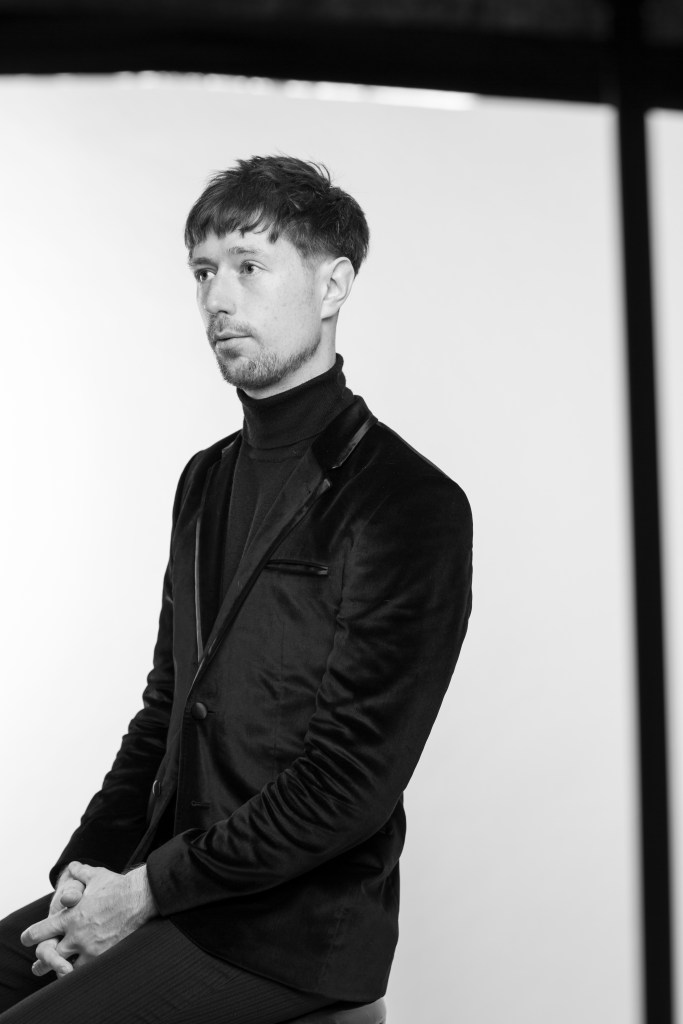
Next Friday sees the release of The Saccharine Underground, the debut album by Glasgow-based art rock outfit, Peter Cat. Well, I say art rock, but in truth it’s very difficult to tie up what he/they do in a neat little package. Essentially Peter Cat’s sound is an idiosyncratic mix of influences and eras – from 60s chamber pop crooners and 70s glam, through to 80s, 90s, and 00s indie, by way of post-punk and all-out pop. Think the love child of Neil Hannon and Alex Kapranos trapped in a Morrisons Local in Glasgow, trying to recreate Scott 3 by memory, equipped only with instruments loaded with presets from This Is Hardcore.
If you are a follower of this blog (unlikely as such a thing might seem) you may have seen last week that I shared a track from the record, the brilliant ASMR, and blethered on about how much I liked it. In time I’ll be doing exactly the same about the other nine tracks that make up The Saccharine Underground, but before then I thought it would be great to put some questions to Peter Cat himself, or rather the man behind the name: musician and songwriter, Graham Neil Gillespie.
Originally my plan had been to combine my review of the record with an interview piece that we conducted by email, but it felt a shame to bundle both pieces together – especially since A) the record is a genuinely astonishing debut, and B) the interview is a fantastic read, and every bit as interesting, charming, and amusing as the music. I think that these things work really well when the artist fully buys in to the process, and that’s definitely the case here. Therefore, I decided that the best way forward was to publish this piece, and then follow it with a full review of the LP next week. So consider this an aperitif, if you will…
(Note: as ever with these things, my questions are in bold and the responses in plain text)
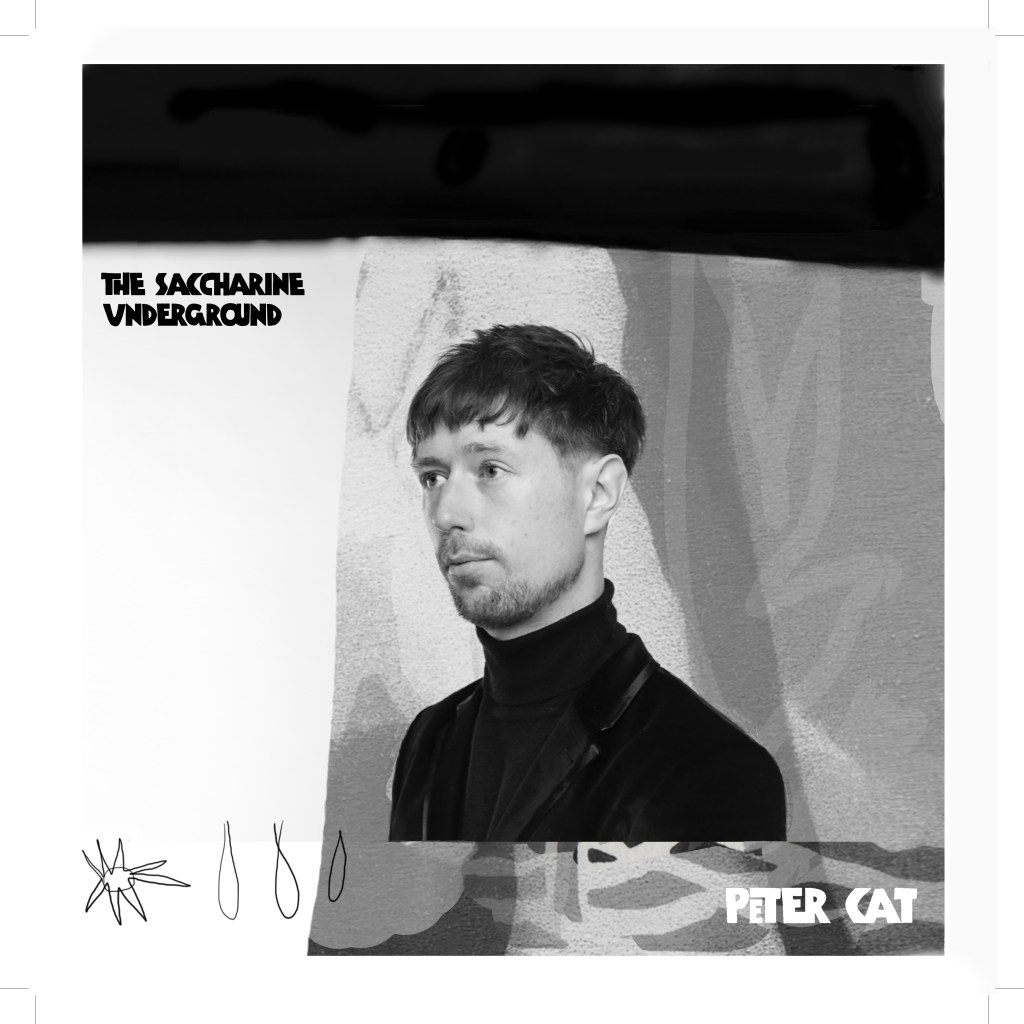
• Much as I hate resorting to generic questions, I thought it would be a good idea to start with a little bit of background on the band. Of course, I say band but I’m not sure who Peter Cat are/is. Could you shed any light?
Historically, Peter Cat has been me, plus whichever unfortunate individuals I’ve managed to strongarm into sharing a stage with me!
I do write all of the music and lyrics, and regularly gig on my own, so to some extent it’s a solo project. But the songs never truly come into their own until they’re performed with a full ensemble of musicians. This past year, I’ve been playing shows with a new band: Beth on bass, Lane on keys and Kev on drums. They’re all incredibly talented, and have really reinvigorated these old tunes of mine. Of course, under “current circumstances”, goodness knows when we’ll all have the opportunity to play together again, but I do miss it so!
• The Day After the Funeral is a really interesting track that sticks out for a few reasons. It’s so massively different in tone to the other nine tracks – in sound and lyrical content, but it also has some incredible lines at the end – “Do you dwell within the stonework now / If I touched it would I feel you now“. It feels more personal I guess, and very specific. But then, you’re wearing so many hats and inhabiting so many characters that you can never be sure as the listener. I’m just wondering where that track came from really? As an aside, I also love how the sombre tone is immediately swept away by So Str8…
Of the ten tracks on The Saccharine Underground, ‘The Day After The Funeral’ is the only one without a punchline. Whereas I habitually inject humour or self-deprecation into almost all of the songs I write – a defence mechanism, as my future therapist will no doubt insist – this wasn’t doable with ‘Funeral’, given the nature of the subject matter.
I’d recently heard that someone I used to go to school with had died. I used to have an enormous crush on this girl: I still have the love letters I wrote to her but never sent. Some of them are pages long! I tried to write a song in memory of her, but of course, by that point I hadn’t seen her in almost ten years, so I didn’t know her at all anymore. Because of this, everything I wrote seemed false; like a betrayal of her. I was extrapolating upon this fanciful notion of the person I’d idealised at age 16, not the reality of the person as she had since become.
So rather than a song about mourning, ‘The Day After The Funeral’ became a song about the impossibility of mourning: about how your world will continue to spin even when another’s has stopped spinning, and that no matter how good your intentions, that void remains fundamentally unbridgeable – with music, words, or otherwise.
• The sequencing of the album is really impressive. I like how it’s kinda exuberant from the off, really burning up energy, and then seems to grow more melancholic towards the end. Then the last track plays out like the end of a night out, when everybody has gone home. Did you have the order in mind quite early on, or was it quite a task trying to get the flow right?
I am a nerd for sequencing, yes. There’s an esoteric art to ordering pieces of music so that they flow in the most satisfying way, and imply a narrative of sorts; even if that narrative is non-lyrical. No matter how many thinkpieces I read telling me that the album format is long-dead, I just can’t seem to shake this impulse to organise!
Back when I was in school, I used to illegitimately procure (sorry mum) single songs, from Limewire and Kazaa and things like that. Then I’d burn a bunch of tracks to a blank CD-R, so I could take them up to my bedroom and listen with headphones in. So even then, you see, I was making critical sequencing decisions; like whether to put Foo Fighters before or after Slayer, or whether the opening track should be Madonna or Gorgoroth.
I knew The Saccharine Underground had to end with ‘Planet Perfecto’. It’s precisely as you say: the outro is a nostalgic ode to the end of a night out, all shimmering trance synths and a big beat fading into absolute nothingness.
• I saw that everything on the record was recorded to tape. There’s shades of a 60s vibe running through (and I definitely picked up on some early Scott Walker vibes creeping in to some tracks – Disappointing Lover kinda feels like it’s got a mix of Jarvis, Neil Hannon, Walker and Brett Anderson going on in particular) and I was wondering what prompted that decision? Are you staunchly analogue, and if so, why?
Oh, is it that obvious…yes, I do harbour an unhealthy obsession with Mr. Walker. He’s the Ur figure of weirdo pop music for me. I didn’t actually get into him until my early 20s, but it was a revelation once I did. Particularly in how he incorporated unsettling dissonance into otherwise conventional pop songs (see the eerie string sections in ‘It’s Raining Today’ or ‘The Electrician’), or sing so theatrically about such bleak subject matter (‘Next’ springs to mind – a song about soldiers contracting gonorrhoea at a brothel). He opened up a new world to me, one where pop music could be wonderfully melodic, yet unapologetically literate, existential, and deeply troubling.
In terms of recording ethos, I do naturally gravitate towards the warmer tones of analogue circuitry and magnetic tape. Not as a rule in all music-making, but it works best for what Peter Cat is. It helps situate the music within a particular sonic genealogy, that of crooner pop, psych-rock and beat pop, and so helps the songs make a kind of intertextual sense. It’s why I recorded the LP at Green Door Studios in Glasgow, who offer a phenomenal range of analogue equipment to work with. Although – replacing one hat with another – I have heard from people much smarter than I that digital software can yield almost identical results these days, and that a $50 program can basically do the same job as a $4000 tape deck. Another one to be filed in the drawer marked ‘The World Is Spinning Too Fast’.
• How do you tend to write? The songs seem so meticulously arranged and it’s difficult to see how you could have started with some of them as there’s so much going on. I’m thinking specifically of a song like (I Want To Break Down) In Your Arms. Do all the songs start in the same way, by the same process? I guess that, over two years, there’s a lot of time for refining things…
There will generally be a nucleus of an idea for each song, something as much conceptual as musical. It’s likely to have been influenced by the work of another artist, something particular I’ve heard that I’ll try to emulate in my own way. With ‘(I Want To Break Down) In Your Arms’, I think I’d been listening to a lot of Jens Lekman at the time, and so had decided I wanted something with a real four-to-the-floor pop bounce, but with plenty of major and minor seventh chords interspersed throughout, to convey a certain breezy or nonchalant quality. Likewise, with ‘Disappointing Lover’, I was trying to capture the kind of stereo wooziness you hear on a Connan Mockasin record, where panning and chorus effects almost make you feel nauseous while listening.
While I’m writing the music for a song, a provisional title will usually pop up out of the blue. That title will have bound up with it a cluster of ideas, stories and sub-plots, a little constellation that I’ll eventually sit down with a laptop and a glass of wine and try to parse out. Sometimes this can take ages: the music for ‘(I Want To Break Down) In Your Arms’ was written years ago, but the lyrics were penned somewhat frantically the night before going into the studio. This isn’t a working method I’d recommend to anyone, and probably goes some way to explaining why I’ve consistently failed to hold down the sort of proper job my parents might approve of.
• The lyrics are consistently great across the record. I laughed out loud several times the first time I listened too, and then found myself at the other end of the spectrum. One thing I think you do really well is include references to things like Reddit etc in a way that doesn’t feel forced. Oftentimes when people make references to technology you can find yourself wincing, but you judge it well. In general, do the words come easy to you? Also, where do you think they come from – are you much of a reader, for example?
I feel like that’s just observational songwriting: talking about the everyday things that people get up to, and farming it for humour and the occasional kernel of truth. I do get what you mean about the potential cringe factor there. But plenty of people – especially straight white men aged 18-30, the demographic I have the misfortune of currently belonging to – do go on Reddit, perhaps with some regularity. For me, it’s much more cringe-inducing when people resort to cliches or exaggerations in their music, without any sense of self-awareness. Like, anyone with an overpriced acoustic guitar and the word ‘troubadour’ in their Instagram bio, singing songs about hills and valleys they’ve never actually seen. You know who you are!
Although I haven’t had time to read much lately, I suppose I have historically been a ‘reader’. I have a PhD in Film Studies, which required quite a lot of reading! I do approach songs like open-ended short stories: I want people to engage with the words and follow the basic narrative as I’ve set it out, but I’m keen that they take their own interpretations away with them. Some of my favourite authors are Margaret Atwood, Umberto Eco, Julian Barnes and Ursula K. LeGuin.
• In terms of influences, what kind of stuff do you listen to? I mean, there are clear nods to Neil Hannon, Franz Ferdinand, Bowie, Pulp, Scott Walker, and Suede to name a few – but if you had to pick, say, five records that are somewhere in the album’s DNA, what would you choose?
You must have known I love making lists…
5. The Left Banke – Walk Away Renee/Pretty Ballerina (1967)
The original baroque pop record, all the way from 1967! Where Belle & Sebastian nicked most of their early career from. It’s got a big shot of hippy psychedelia running through it, but that’s tempered by beautifully terse, fragile instrumentation. Compared to the looseness of contemporary psychedelic rock, this is a taut record; even tense at points. Yet it’s still a meticulously arranged pop album! I love this duality that it has, and how otherworldly some of the songs feel.
4. The Lemon Twigs – Go To School (2018)
If you’re going to be rock-revivalist this deep into the 21st century, then this is absolutely how you do it. Production-wise, this record was a big influence on myself and Chris who mixed The Saccharine Underground. The guitars sound clear and crisp, yet massive; the vocal harmonies, utterly gorgeous. The orchestral instruments sit so sweetly alongside everything. And of course, the songs are great!
3. Momus – Tender Pervert (1988)
Momus, aka Nick Currie, aka the brother of Justin Currie, the singer from Del Amitri. While Justin is no doubt sat atop a much larger pile of cash these days, Nick is the infinitely more talented sibling. Tender Pervert is a collection of hyper-literate song-poems, sung in a semi-whisper, set to some extremely 80’s-sounding synth-pop. It sounds extremely weird to modern ears, but there’s nothing like it. Whenever I think I’m in danger of becoming too obtuse with my writing, I’ll think of how much I love Momus, and my worries will subside.
2. The Divine Comedy – Casanova (1994)
Most songwriters and lyricists that I’m into, I’ll be into them from a distance; as in, I’ll be awed by their work and output without necessarily feeling particularly close to them as people. Which is healthy, in a ‘never meet your heroes’ sort of way, right? But with Neil Hannon, I feel like the guy is my brother from another mother. He’s quite a weirdo, never really fit into any music scene or was part of anything resembling cool, yet through his unabashed theatricality, dedication to his art and a brilliant sense of humour, he’s had a fantastic career. I aspire to be a lot of what he is, and would like to go for a pint with him, too.
1. David Bowie – Low (1977)
It’s the hipster’s choice of Bowie albums, I know! But it’s just so good, too good. The first side sounds totally radical, even now. It anticipated pretty much all of post-punk. And Side B, the instrumental side, takes me to places in my mind that no other music has ever taken me to. I best put a stop to the hyperbole train now, before it runs off the tracks!
(I’m aware that this list is comprised of exclusively white dudes. When you’re making guitar-based music in the indie and baroque pop genre, that can be an occupational hazard, unfortunately. But while these five records are probably the closest in sound to The Saccharine Underground, I have to reserve very honourable mentions for Aimee Mann’s Bachelor No. 2, Janelle Monae’s The Archandroid, Aldous Harding’s Designer, and basically anything Dory Previn ever wrote. While The Saccharine Underground may not sound much like those artists or records, their ideologies and philosophies – whether it’s Monae’s cyberpunk futurism, or Previn’s ability to combine the brutally honest dissection of her personal life with razor sharp social and political commentary – are very close to my heart.)
• What are your plans going forward. Is there another record on the cards already?
Pre-lockdown, the plan was to hit the studio with a fresher batch of songs with my band, and record album number two. It was tentatively called ‘The Magus’, inspired by the John Fowles novel of the same name. It was to be more of a collaborative effort, with the band all tracking our parts live in the room. But with covid surging again at the moment, it’s not an ideal time to be knuckling down for regular practise sessions in close quarters, not to mention using shared rehearsal or recording spaces. I still hope to make this record with the band – it’s just hard to say when at the moment.
But, during lockdown, I did write another album’s worth of material: half traditional record, half musical theatre. A ‘popopera’, if you like. Sounds terrible, doesn’t it? It’s called ‘Don Sequitur’, and you could say it’s a concept record about always saying the wrong thing. Or, if you do think of the right thing to say, you always think of it too late. ‘L’esprit de l’escalier’, they call it in French – ‘spirit of the staircase’, because the perfect line only occurs to you once you’re halfway down the stairs to leave. I’m already planning to record ‘Don Sequitur’ as properly as possible on my modest home studio setup, and release it as a follow-up to The Saccharine Underground, possibly along with a book of short stories. The possibilities are endless – so long as I stay within my bubble!

You can find Peter Cat on Instagram, Twitter, and Facebook. The Saccharine Underground will be available everywhere November 6.
 I stood up & I said yeah
Leave a comment